
ROYTEC: Following The Cycle

Filtration and separation equipment specialist, Roytec, sits in a comfortable position, using all of its South African knowhow, working on some of the world’s premier gold mines, to expand globally. Now with a presence across five continents, the company is becoming known as an industry leader that does the right things by its clients. Sales Director Hoosen Essack and Engineering Director Krzysztof Szymczak talk to Enterprise Africa about a company in the right place at the right time.
Supported by:

Africa’s mineral wealth has become one of the defining stories in global industry. Analysis from S&P Global projects the continent will supply around 60% of the world’s lithium and 76% of its mined cobalt by 2030, positioning it at the centre of a scramble between global powers for the raw materials that decarbonisation depends on. Behind that headline story sits a quieter one: the equipment suppliers who have to keep pace with a mineral mix that never stops shifting, moving from gold to copper to lithium to rare earths as fast as global demand changes direction. Roytec, a specialist in liquid-solid separation and mineral filtration, has built 25 years of business on exactly that kind of movement, and its leadership sees the constant change not as a risk to manage but as the whole reason the company exists.
“We are a solid-liquid separation business and our focus is supplying services to various mining companies,” says Engineering Director Krzysztof Szymczak, describing a product range built around thickeners, clarifiers, flotation cells, filters and ion exchange plants that sit at the heart of how a mine turns ore into a saleable product. Gold, he notes, remains a strong performer, but the wider portfolio is deliberately built to move with whatever commodity is in favour. Sales Director Hoosen Essack explains: “We follow the commodity cycles globally because we are an equipment supplier into minerals processing. We have seen that the mining cycle is dependent on demand for commodities based on innovation in the way they are used.”
FOLLOWING THE CYCLE
That dependency has played out vividly in recent years as electrification and decarbonisation projects gather pace alongside traditional industrialisation developments around the world. “Copper flies when there is a lot of industrialisation, and there is big need when expanding electrification in residential and industrial complexes. Lithium has taken off, rare earths are on the rise, uranium is moving well, and gold follows its traditional cycles,” Essack says, and it is that spread across commodities, rather than a bet on any single one, that determines where Roytec focuses its energy next – a strategy that has served the company well.
Founded in 2001 by Alan Fanton and Mark Langton, Roytec began, in Essack’s words, “as a very small entity, as a group of colleagues that came together after working together at different times throughout their careers.” Fanton remains CEO, while Langton continues as a director running related businesses that Roytec partners with on iron exchange technologies.
Growth from there was deliberately natural. “We have grown organically from a South African-based business, becoming a sub-Saharan African business, and now a global business,” Essack explains. “For the first 15 years, we were focused on Africa and bedding down our roots but we stepped out of that space into Australia before moving into Canada, South America, and then Europe.” Roytec now operates from Perth, Toronto and Yantai as well as Johannesburg, a footprint built one region at a time rather than all at once, in step with where the mineral cycle happened to be pointing.
Both directors arrived at Roytec by a similarly gradual route. Essack began in engineering, doing laboratory and pilot plant test work before moving into sales and technical roles and joining the company in 2003. Szymczak’s path ran through the client side first: he started designing the company’s first pinned bed clarifiers and thickeners as an external consultant in 2005, working for years as one of Roytec’s own customers before being invited to join as Engineering Director in 2019. That kind of inside-out perspective, gained from sitting on both sides of the table, now shapes how the engineering team thinks about what mines actually need rather than what a catalogue says they should want.
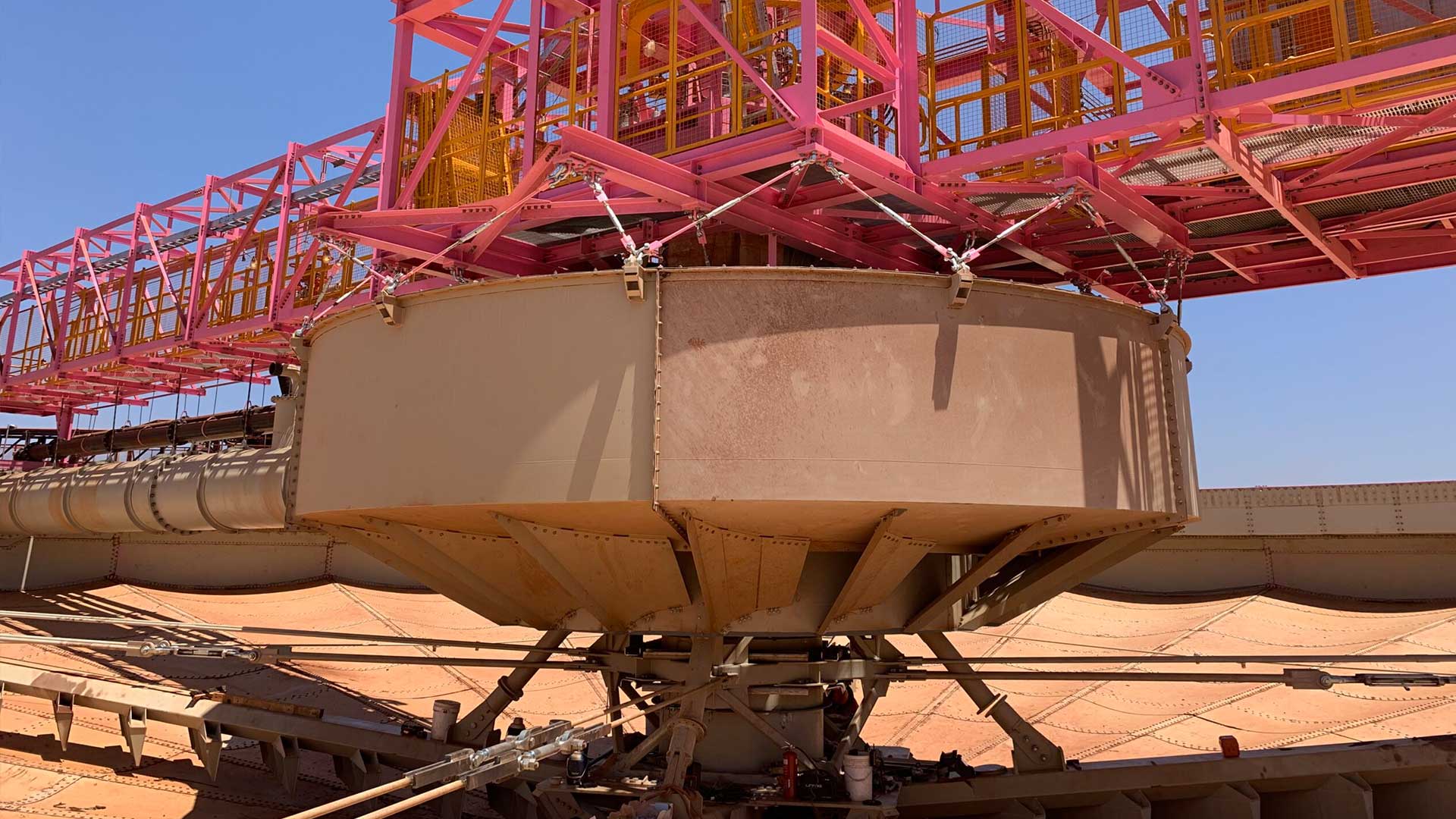
Images © Roytec
ONE GLOBAL CLIENT
It is a mindset that matters more than ever as the geopolitics of critical minerals intensifies. The S&P Global analysis that tracks Africa’s growing share of global supply also points to an accelerating contest for access, with the United States, China and a widening circle of so-called middle powers all competing for position on the continent. For a supplier like Roytec, sitting inside that contest rather than watching it from the sidelines, the advantage comes from familiarity rather than scale. “The clients we deal with on a global basis are often the same as those we deal with on a local basis,” Essack says. “If we have dealt with a global corporate in South Africa or Africa, that is the same client that you would need to deal with elsewhere as they have the same outlook, requirements, methods, and standards everywhere. All of the major EPCM companies that work for the global miners are key clients for us and we deal with their offices around the world,” he adds.
That consistency extends down to the detail of how business gets done. “Their expectations are similar across North America, Europe, Africa, and Australia. Their company philosophy and culture is what we work to, and we have to be very aware of their supply chain systems and expectations,” Essack notes, while Szymczak points to the supplier side of the same equation. “We have great relationships with suppliers who we partner with for the long-term and work together globally,” he says, citing joint projects spanning South Africa, Mexico and Australia as evidence of how far those partnerships now travel.
Many of those clients, and suppliers, are listed entities, and that status cuts both ways. “They have an onus to report to shareholders and a requirement to the environment that they work in across various countries. There is a level of comfort in that for us as they are not unknown,” Essack says, though he is candid about the flip side. “It can be painful if organisations of that scale are discontinued for whatever reason. We have seen both sides and have been fortunate to not experience negativity more often.” It is the kind of exposure that would unsettle a supplier without Roytec’s spread across commodities, geographies and client types, but for a business built to move with the cycle rather than against it, the occasional loss is absorbed rather than existential.
SUPPLY WHAT OTHERS CAN’T
The company’s engineers now carry a combined total of more than 150 years of mineral separation experience, the kind of institutional depth that lets Roytec take on specialist work in gold, rare earths and battery minerals alike without having to build fresh expertise from scratch each time demand shifts. That range has translated into results: the business has previously reported more than R240 million in equipment orders moving through final investment decision within a single two-quarter window, spanning projects as varied as dry stack tailings for a vanadium mine and rare earth and lithium developments across Australia and Canada. Few competitors can match a portfolio broad enough to service that spread without leaving gaps.
Essack is unambiguous about where that ability to keep expanding actually comes from. “Right now, as an organisation, we believe our growth is due to the fact that we continue to do the right thing for our customers and the market. They are satisfied with our product and service so much so that they allow us to expand with them into other regions globally,” he says. It is a relationship that runs in both directions, with long-standing clients effectively opening doors into new markets as Roytec follows them there. “We have always been a company that looks closely at equipment development and process development with the client in mind, providing support that they appreciate, and that is why we are where we are. If you don’t do that in this market, you quickly get penalised.”
As the demand cycle turns once again, this time towards the rare earths and battery minerals that the energy transition depends on, Roytec’s willingness to move with it, rather than anchor itself to a single commodity, remains the clearest explanation for how a company built in South Africa now services listed miners on five continents. “We believe we do the right things, and we will continue to do more of that same and improve on that,” Essack says, and for a business whose fortunes rise and fall with whatever mineral the world happens to need most, that continuity may be the only constant worth relying on.