
SHEPSTONE & WYLIE: More Than 130 Years of Getting It Right

One of South Africa’s top law firms is moving forward with pace and ambition as it seeks to remain a trusted partner for clients in a changing world. A new management partnership took the reins of the company at the end of 2025, and Anton Lockem and Samantha Davidson are clear that organic, sustainable growth will come through the delivery of excellent service.
Supported by:


There is a particular kind of law firm that South African business needs and rarely finds: large enough to cover every specialism a sophisticated client might require, small enough to know that client’s affairs intimately, and independent enough to give advice that is genuinely in the client’s interest rather than calibrated to the billing rate. Shepstone & Wylie Attorneys, founded in Durban in 1892, has spent more than 130 years occupying exactly that position — and under a new joint managing partnership that took the helm in September 2025, it is building on that foundation with fresh energy and a clear sense of where the firm is going next.
The statistics alone give a sense of scale. Around 220 people work across the firm, including approximately 100 attorneys, paralegals and consultants and around 40 partners. The head office is in Durban, with branches in Cape Town, Johannesburg, Richards Bay and Pietermaritzburg. “We are one of the oldest and the largest law firm in KwaZulu-Natal,” says Anton Lockem, who leads the firm jointly with Samantha Davidson. “We are, in the South African context, a medium sized law firm. We cover almost every aspect of law, apart from criminal law.”
That breadth is a deliberate positioning that has made Shepstone & Wylie the firm of choice for clients whose affairs span multiple legal disciplines and who need those disciplines to speak to each other.
The appointment of Sifiso Msomi as Chairperson of the Board of Shepstone & Wylie at the same time as the appointment of the new Joint Managing Partners, underscores the firm’s depth of expertise and clear vision for the future while reinforcing a continued commitment to excellence, transformation and diversity within the legal profession. Appointment to the role of Chairperson recognises Msomi’s deep legal expertise and decades of service. He brings exceptional knowledge and authority to this position. His leadership in property law, encompassing sectional title transactions, notarial bonds, leases, servitudes, and general conveyancing, has earned him wide respect in the legal community.
Beyond his professional practice, he has made notable contributions to national institutions and community organisations. He has served as a member of the Judicial Service Commission, the KwaZulu-Natal Planning and Development Appeals Tribunal, and held leadership roles within the Black Lawyers Association, the Durban Chamber Foundation, and the Durban ICC. Deeply committed to transformation and community development, he currently serves as the chair of the Ithwelenye Development Initiative. In addition, he is an internationally accredited mediator through the Centre for Effective Dispute Resolution (CEDR), with a particular focus on property-related disputes. His legal expertise, leadership skills and dedication are all apparent in the role he plays as Chairperson of the Board.
Davidson brings three decades of institutional knowledge to the managing partner role, having joined the firm when entering the industry and building her reputation as one of South Africa’s foremost pension lawyers over decades.
“I have been with Shepstone and Wylie for 30 years and I did my articles here,” she says. “I am a pension lawyer and specialised in pension law for many years. I became joint managing partner in September 2025 after our managing partner of the past 20 years retired. There is a new positive energy in the business that comes from change.”
Lockem joined in 2010 to establish the firm’s tax department, building it into a significant practice while maintaining his own client-facing work. “Tax is now a significant part of the business,” he says. “We both remain active in our roles with pension and tax, but we also put a major amount of attention into the joint managing partner role, which takes up a considerable amount of time.”
The joint structure itself is a statement of the firm’s values. Two senior practitioners, each expert in their own field, running the business through active collaboration rather than hierarchy. “The way we collaborate with each other is unique,” Lockem says. “We never have just one view and run with it. We always have the opportunity to bounce ideas and strategies off each other, and that is very helpful as we can pick up on potential blind spots and opportunities. That enables us to give a better value proposition to everyone at the firm.”
Davidson adds a dimension to this that goes beyond management style: “We have a very diverse workforce and it’s good to realise that we have different opinions on things. We can share different ideas to, ultimately, get the best outcome for our clients.”
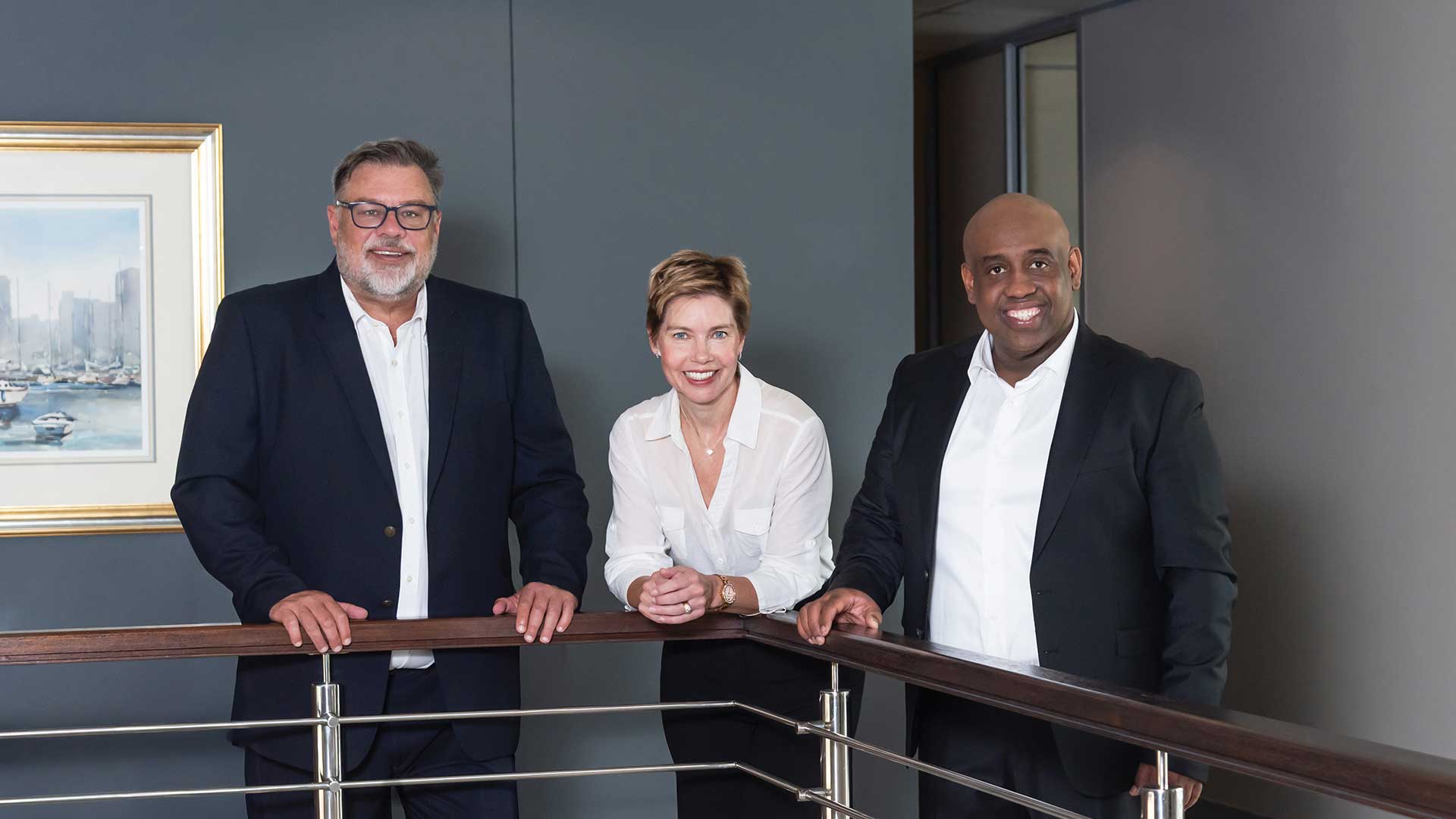
Anton Lockem, Samantha Davidson (Joint Managing Partners) and Sifiso Msomi (Chairperson)
BREADTH AND DEPTH
The service range at Shepstone & Wylie covers virtually every legal need a South African business might face. The customs, shipping and international trade practice operates on a national basis with offices at all major ports — Durban, Cape Town and Richards Bay — and in Gauteng. The firm also has experts in corporate and commercial law, competition and antitrust, B-BBEE advisory, employment law, environmental law, property law including conveyancing, pension law, tax, exchange control litigation, arbitration, banking and finance, insolvency and business rescue, insurance, construction and engineering, land claims, and local government and administration.
A clean energy practice sits within the environmental department, reflecting the changing demands of a South African business community navigating the energy transition.
“Our customs and shipping team is wonderful and they operate on a national basis, like most of our disciplines,” says Lockem.
New practices are being added where the market demands. Global mobility and immigration are recent additions. Davidson explained “We have a new project in global mobility law as we are seeing many digital nomads coming to work in Africa but receiving their salary in dollars or euros. There is a skills shortage in some areas so certain of our corporate clients are looking to bring in international skill on short term visas — that is a new service line that we have recently started with.”
Intellectual property, previously referred externally for strategic reasons, is now addressed through a joint venture with a specialist IP firm, Mtshali and Associates, giving clients seamless access to that expertise without leaving the Shepstone & Wylie relationship.
The collaboration that Lockem and Davidson describe as central to the firm’s culture is not merely a management philosophy — it translates directly into how clients are served. “If a pension client has a tax query, we can easily answer that question because we are so collaborative,” Lockem explains. “If that then turns into an employment enquiry, we can answer it easily. That separates us from other law firms, and it allows us to scale.”
For a business client whose affairs may touch corporate structuring, tax planning, employment matters and property transactions simultaneously, having a single firm that can address all of those without internal boundaries or referral friction is a material advantage.
The pricing dynamic that flows from the firm’s scale is equally significant. “Because we are a medium sized law firm, we provide most of the specialised services that the larger competitors provide, but because of our economies of scale, we generally provide it to our target market at a price that is not as challenging as what you may find in the larger or boutique style firms,” Lockem says. That combination — the specialism of a big firm, the accessibility of a mid-size one — defines the gap Shepstone & Wylie occupies in the South African legal market.
TRUSTED FOR GROWTH
The firm’s financial trajectory reflects a business in consistently good health. “We have achieved year-on-year growth consistently. We have grown every year since I can remember,” says Lockem.
The current strategic target is sustainable organic growth — not acquisition-driven expansion, but rather developing our juniors and strengthening the client experience.
The firm’s client engagement programmes are a practical expression of that approach. Monthly events on targeted topics for targeted audiences create two-way conversations that help the firm identify what the market needs before clients have to ask for it. “We do a lot of presentations to clients, and we identify areas which we know are important for them,” Davidson explains. The recent collaboration with the firm’s IP joint venture partner to address soft IP issues — business restructuring, value recognition — is one example of how those conversations translate into new service capabilities.
International reach is also expanding. Membership of the International Bar Association has opened dialogue with lawyers of major firms worldwide, and the insights have been affirming. “We have just attended a conference in London where we engaged with Managing Partners from across the world, including some of the largest law firms in the world, and the learnings were very insightful and interesting,” Lockem says. “We found that the issues facing a firm like us and our ideas on sustainable growth and AI are very consistent with those being implemented by some of the largest firms in the world.”
South Africa’s legal sector is evolving rapidly. The demand for technology-aware practitioners is growing, cross-border commerce is creating new complexity in areas like customs, competition and mobility, and clients are increasingly sophisticated in their expectations of what a legal partner should deliver. In that environment, the firms that will define the next decade are those that can combine genuine specialism across multiple disciplines, a culture of collaboration that translates those disciplines into seamless client service, and the commercial clarity to price that service accessibly. “We want to be known as a firm that is driven by the values of diversity and collaboration,” Lockem says. “We are not too big and not too small so we can fit perfectly into that role, just as we have done for more than 100 years. Internally, we drive loyalty and respect across all of the partners. When it all fits together, there is a major benefit for the client.”
After 133 years of doing exactly that, Shepstone & Wylie shows every sign of continuing to do so for another century and beyond.